

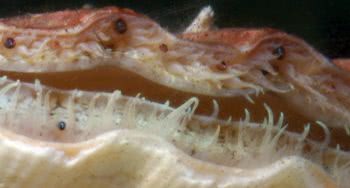
A front view into the "face" of a Scallop: Note the eyes around the edge of the mantle and the sensitive "tentacles".
There are a variety of different scallop species from the Small Scallop to the large Thorny Scallop. They all have a symmetrical shell except for the two wings that come off the base, near the hinge. The top shell is domed whilst the bottom half of the bivalve is flattened. Scallops have a reasonable eyesight and around the rim of the shellfish the small eyes can be clearly seen. One predator it watches out for is the starfish. These feed on bivalves and if the scallop sees one it does a "dance" by shutting the two shells quickly ejecting water. By this jet propulsion it can fly up into the open water away from the bottom and the predator. Young scallops, unlike their free parents, are attached to the rock by byssus threads. Scallops are suspension feeders, filtering the food out of the water. There is only one muscle for closing the two shells together whilst most bivalve molluscs have two.
Scallops live away from the shore in deep water but young ones do appear in the lower shore of rocky seashores. Often abundant along most shores of Europe . An important fisheries shellfish.
Looking for a next step?
The FSC offers a range of publications, courses for schools and colleges and courses for adults, families and professionals that relate to the seashore environment. Why not find
out more about the FSC?

FEEDBACK
Do you have any questions?
Copyright © 2008 Field Studies Council

Creative Commons Attribution-Noncommercial-No Derivative Works 3.0 Licence .
Site Statistics by Opentracker